
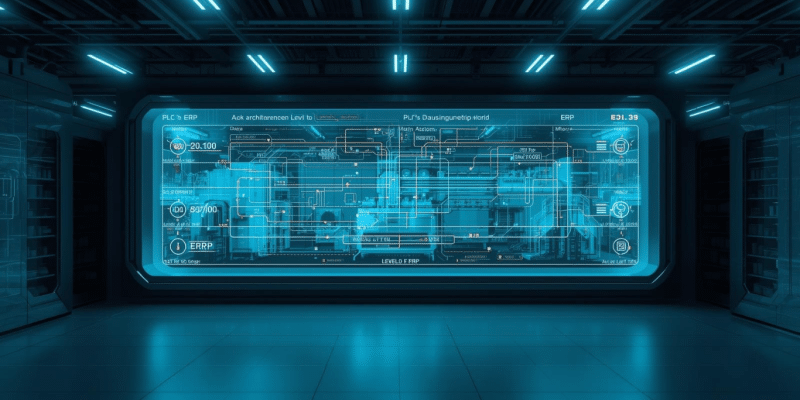
From PLC to Profit: Rethinking of Manufacturing Data Stack
Digital transformation in manufacturing is no longer about installing new machines. It is about how systems actually connect. Many Indian plants have modern PLCs, upgraded SCADA, and ERP systems in place. Yet profitability does not improve at the same speed as automation investment. The missing link is not hardware. It is IT OT Integration.
Think of your plant like a nervous system.
Sensors are the nerve endings. PLCs are reflex centres. But unless signals reach the brain in structured form, intelligent action cannot happen. The same applies to your data stack.
The Invisible Gap Between PLC and Profit
Every manufacturing plant today generates enormous operational data. Temperature readings. Machine cycles. Energy consumption. Batch parameters. Downtime logs. But data generation alone does not create value. Value comes from connection, interpretation, and action. This is where IT OT Integration becomes critical. When operational technology (OT) systems like PLCs and SCADA operate separately from IT systems like ERP and analytics platforms, information remains fragmented. Decision-making slows. Meetings increase. Profit impact weakens. Plants often believe they are data-driven. In reality, they are dashboard-driven.
Understanding the Traditional Manufacturing Stack (Level 0–4 Model)
A typical plant architecture follows this structure:
- Level 0–1 – Field devices and PLCs
- Level 2 – SCADA systems
- Level 3 – MES
- Level 4 – ERP
On paper, this looks organised. In practice, these layers frequently operate in silos.
Data flows upward, but rarely flows intelligently across layers.
For example:
- PLC data may be visible in SCADA.
- SCADA data may be archived in a historian.
- ERP may receive summarised production values.
But these systems often lack unified context. Without structured tagging, event linking, and standardised protocols, integration becomes manual. This is why many plants rely on Excel for reconciliation. That is not integration. That is patchwork.
Where the Breakdown Happens
- Data Duplication: Multiple systems store similar data. Energy data exists in SCADA, historian, and spreadsheets. None agree perfectly.
- Manual Reporting: Operations teams export CSV files to validate numbers. Time spent validating data reduces time spent optimising performance.
- Lack of Contextualization: Raw tags exist. But they are not structured as Area → Subarea → Machine → Asset → Parameter.
Without context, analytics becomes guesswork.
- Fragmented Integration Management Systems: Many plants adopt integration tools reactively. Different vendors implement different connectors. Over time, integration management systems become complex and expensive to maintain. The result is technical debt.
So How Do Systems Actually Connect?
Imagine a railway network. If tracks are misaligned, trains cannot reach destinations efficiently. Adding more trains does not solve the problem. Aligning the tracks does. In manufacturing architecture:
- PLCs generate signals.
- Gateways collect and standardise them.
- Protocols such as OPC UA or MQTT ensure interoperability.
- A centralised historian organises time-series data.
- An IoT visualisation platform presents structured dashboards.
- ERP consumes clean, aggregated outputs.
Connection must be horizontal as well as vertical. Traditional stacks move data vertically. Modern Industrial IoT solutions create a unified data layer that connects across assets, utilities, and departments. This is the shift from automation maturity to architecture maturity.
The Modern Data Stack: Horizontal, Unified, Scalable A future-ready manufacturing data stack includes:
Unified Data Acquisition: Standardised protocol support ensures device-agnostic integration. This reduces vendor lock-in and simplifies expansion.
Edge-to-Cloud Hybrid Architecture: Local processing ensures reliability. Cloud integration enables scalability and multi-location visibility. Indian manufacturing environments particularly benefit from hybrid models due to connectivity variability and cybersecurity considerations.
Structured Data Context: Tags are not random variables. They are organised hierarchically.
Area → Subarea → Asset → Parameter.
This enables real-time OEE analysis, energy benchmarking, and root cause identification.
Central Historian as Intelligence Layer: A historian is no longer just a storage. It is the memory and intelligence backbone.
When integrated properly within an IT OT Integration framework, the historian enables:
- Event correlation
- Batch traceability
- Energy trend forecasting
- Performance benchmarking
IoT Visualisation Platform for Decision Speed
Dashboards should not overwhelm. They should filter. A strong IoT visualisation platform connects analytics to operations leaders in structured, role-based formats. This reduces meeting dependency and accelerates decisions.
Financial Impact: Connecting Architecture to Profit
Architecture discussions often feel technical. But their impact is financial.
Consider these operational realities:
- A 5% improvement in OEE can significantly increase annual profit margins.
- Energy optimisation through real-time monitoring can reduce operational costs within months.
- Faster reporting cycles improve management agility.
When IT OT Integration eliminates manual reconciliation and ensures real-time transparency, decision latency drops.
Decision latency is an invisible cost. Reducing it creates a competitive advantage. Profit does not begin at ERP.
It begins with clean, contextualised plant-level data.
Why IT OT Integration Is Becoming Strategic
Earlier, integration was treated as a technical necessity. Now it is a board-level discussion.
Reasons include:
- Multi-location plant management
- Sustainability reporting
- Regulatory compliance
- Predictive maintenance initiatives
- AI readiness
Without unified integration management systems, these initiatives remain isolated pilots. Integrated architecture enables scale. This is why leading Industrial IoT solutions now emphasise interoperability, cybersecurity, and flexibility rather than just device connectivity.
Practical Roadmap for Plant Heads
You do not need a complete system overhaul to rethink your stack.
Start with clarity.
Step 1: Map Current Data Flow. Document how data moves from PLC to ERP. Identify manual intervention points.
Step 2: Identify Excel Dependency. If daily reviews require manual exports, integration is incomplete.
Step 3: Standardise Protocols. Transition from legacy DCOM-based systems toward modern standards like OPC UA and MQTT.
Step 4: Implement Structured Tagging. Organise plant data logically. Context improves analytics accuracy.
Step 5: Pilot a Unified Industrial IoT Layer. Select one use case. Energy monitoring. OEE accuracy. Downtime analysis. Prove ROI before scaling.
Common Myths to Reconsider
Myth 1: More dashboards equal better control.
Reality: Structured data equals faster decisions.
Myth 2: Cloud-first solves integration problems.
Reality: Hybrid models often provide better reliability.
Myth 3: Integration is a one-time project.
Reality: It is a strategic capability.
The Future: Competing on Architecture Maturity
The next wave of manufacturing competition will not revolve around machine brands. It will revolve around system design. Plants with mature IT OT Integration will:
- Adapt faster to market fluctuations
- Optimise energy intelligently
- Reduce unplanned downtime
- Support sustainability reporting
- Enable AI-driven process optimisation
Those without a structured architecture will struggle with fragmented data. Industrial IoT solutions are evolving rapidly. But technology alone is insufficient. The true differentiator is how well systems connect, communicate, and contextualise information.
Final Takeaway
How do systems actually connect?
Not through cables alone. Through architecture.
From PLC to profit, the journey is not linear. It requires unified IT OT Integration, robust integration management systems, scalable Industrial IoT solutions, and an intelligent IoT visualisation platform.
Manufacturing excellence in 2026 will not belong to the most automated plants. It will belong to the most connected ones.
Comments are closed