
Written by Ketsol Manufacturing Suite
Industrial Data & AI Practitioners | OT/IT Convergence Specialists.
Ketsol is an industrial technology firm specialising in data infrastructure for manufacturing environments. With over 15 years of experience across discrete and process industries, the team has delivered large-scale data architecture and IIoT implementations, including work with Tier-1 manufacturers.
Core expertise includes Unified Namespace (UNS) architecture, industrial data modelling, and AI readiness for production systems. Ketsol combines deep operational understanding with modern data engineering practices to bridge the gap between OT and enterprise systems.
Published: March 2026
Most manufacturing data strategies fail because data is visible but not actionable.
According to McKinsey, manufacturers capture less than 30% of the potential value from their data. The primary reason is not a lack of data; it is fragmentation and a lack of integration across systems.
At Ketsol, we have worked with manufacturing environments across automotive, food processing, and discrete industries. The issue we encounter most consistently is not data availability. It is what happens or does not happen after data is collected.
The core gap:
Dashboards answer “What is happening?”
They do not answer “Why is it happening?”, “What should we do next?”, or “How quickly can we respond?”
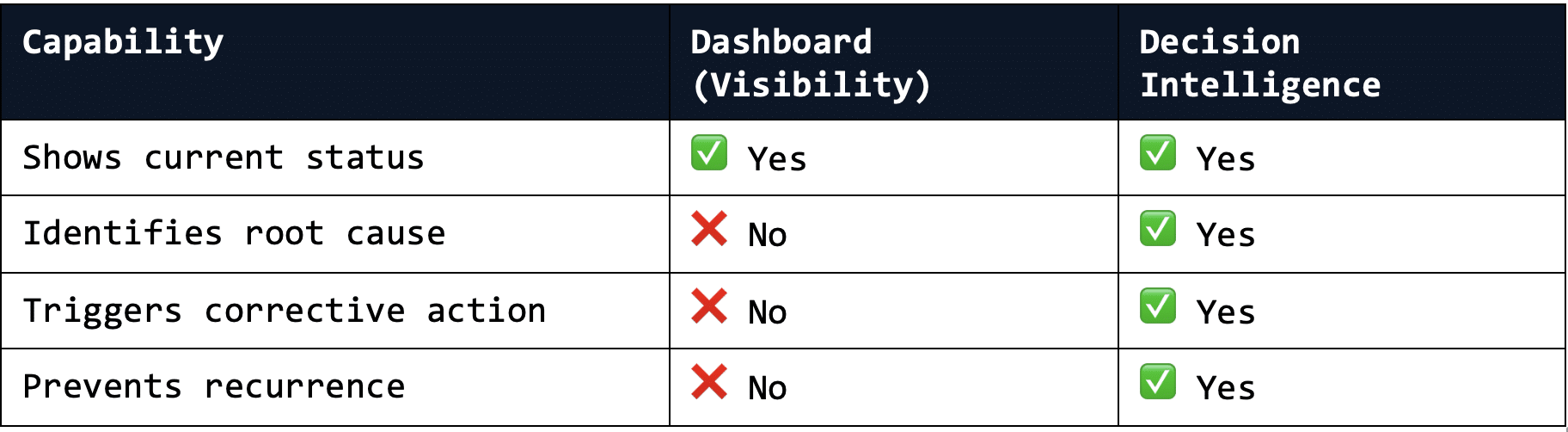
A dashboard may display a temperature spike. It will not identify the root cause, trigger corrective action, or prevent recurrence. That gap between visibility and action is where manufacturers lose time, efficiency, and revenue.
Most factories operate across four disconnected layers, aligned with the ISA-95 framework:
In practice, these layers communicate through point-to-point integrations, which create exponential complexity as operations scale:
According to Gartner, integration complexity is one of the top barriers to scaling Industry 4.0 initiatives.
In a recent engagement with an anonymised mid-sized discrete assembly manufacturer, Ketsol observed the following before any architectural changes were made:
After restructuring the data architecture with a unified approach:
This pattern is consistent across the manufacturers we work with not an exception.
Want to see where your current data architecture stands? Request a free assessment →
A Unified Namespace (UNS) is a centralized, structured data layer where all systems publish and subscribe to real-time information.
Instead of point-to-point integrations (like direct phone calls between systems), a UNS functions like a shared communication platform — every system speaks to one place, and listens from one place.
Key enabling technologies:
Business impact of UNS adoption:
Ketsol’s unified data solutions are built around this architecture — helping manufacturers implement UNS without heavy integration overhead or lengthy deployment cycles.
Raw data alone is unactionable. Consider this example:
❌ Temp_01 = 85°C — meaningless in isolation
Using ISA-95-aligned data structuring, the same reading becomes:
✅ Plant A → Line 2 → Reactor 3 → Temperature = 85°C
Contextualized data enables:
This contextualisation layer is one of the foundational principles behind how Ketsol structures data within the Ketsol Manufacturing Suite (KMS).
Event-driven manufacturing is an architecture where systems actively respond to data conditions — rather than waiting for human review of dashboards.
Once data is unified and contextualized, manufacturers can automate responses:
According to Deloitte’s Smart Factory research, event-driven systems significantly reduce response latency and improve operational agility. This is where data converts into operational leverage.
Unified architecture uses a hub-and-spoke model:

This model enables rapid multi-plant rollout with standardized data models and reduced engineering overhead per site — a core capability within Ketsol’s manufacturing data solutions.
When unified data architecture is implemented effectively, manufacturers typically achieve:
The shift: Data moves from a passive reporting asset to an active driver of operational performance.
Start with data architecture not more tools.
Adding dashboards or analytics platforms on top of a fragmented data layer increases complexity without addressing the root problem.
Recommended sequence:
This is the exact methodology Ketsol follows when working with manufacturers at any stage of their Industry 4.0 journey.
Ready to move beyond dashboards? Talk to the Ketsol team →
1. What is a Unified Namespace (UNS)?
A Unified Namespace is a centralized data architecture where all industrial systems publish and subscribe to real-time data in a structured format, eliminating point-to-point integration complexity.
2. How is MQTT used in manufacturing?
MQTT enables lightweight, real-time communication between machines and systems using a publish–subscribe model, making it ideal for scalable industrial data architectures.
3. Why do manufacturing dashboards fail to deliver ROI?
Dashboards provide visibility without enabling action. Without integration and automation, insights remain unused and response times stay slow.
4. What standards govern industrial data architecture?
5. What is the Ketsol Manufacturing Suite (KMS)?
KMS is Ketsol’s purpose-built solution for unifying, contextualising, and activating industrial data — without heavy integration overhead.
Learn more or request a demo →
The competitive advantage in manufacturing will not come from collecting more data. It will come from acting on data faster and more intelligently than competitors.
Manufacturers that succeed will move beyond dashboards, invest in scalable data architecture, and enable real-time, event-driven decisions at every level of the operation. The value of data is not in seeing it, it is in acting on it.
About This Article
This article is based on industry best practices and real-world implementation experience from Ketsol’s work across manufacturing environments adopting Industry 4.0 architectures, including MES integration, IIoT deployment, and unified data strategies aligned with ISA-95 standards. Published by the Ketsol Team | www.ketsol.ai